

Pi coding agent: a minimalist approach to AI coding agents
In recent months, the AI coding agent market has become increasingly crowded with ever more sophisticated tools. Automated planning, sub-agents, multi-step workflows and native integrations all promise to reduce developers’ workload and boost productivity.
In this landscape, Pi, the project developed by Mario Zechner and available through pi.dev, takes a different direction. Instead of continuously adding new features, it aims to reduce the core to the essentials and leave developers in control of their own working environment.
The project’s promise is captured in a simple statement.
“Adapt Pi to your workflows, not the other way around.”
A philosophy that may seem counterintuitive, yet it opens up an interesting discussion about the future of AI coding agents.
Rather than focusing solely on a single tool, it is worth using Pi as a unique vantage point from which to explore an emerging trend: the search for AI coding agents that are simpler, more transparent and more controllable by developers.
When more automation means more complexity
Many modern coding agents aim to become increasingly autonomous. While this evolution brings clear benefits, it also introduces new forms of complexity: ever-growing system prompts, workflows that are difficult to understand, and behaviors that change with every release.
Pi was created precisely as a response to this trend. The goal is not to make the agent smarter or more autonomous, but to reduce the friction introduced by the harness (a term used to describe the software infrastructure surrounding an LLM or AI agent) and keep control in the hands of the people using it.
Pi coding agent: a minimalist harness
The official definition is straightforward: Pi is a minimal terminal coding harness.
At its core are just four fundamental tools: read, write, edit and bash. Everything else is moved outside the core through TypeScript extensions, on-demand skills, prompt templates, themes and packages distributed via npm or Git. A lightweight Terminal User Interface (TUI) completes the experience.
Pi can also be used in interactive, JSON, RPC or SDK mode. More than a simple terminal-based agent, it presents itself as a composable platform that can be adapted to the needs of individual developers or entire teams.
Context as a design responsibility
One of the most interesting aspects of the project is how it handles context. Pi places particular emphasis on what actually enters the model’s context window.
Files such as AGENTS.md and SYSTEM.md, together with skills and extensions, make it possible to explicitly control which information reaches the model. It is also possible to extend or override the default SYSTEM.md through local configurations.
The difference compared to many other tools is significant: context is not treated as a hidden implementation detail, but as a design responsibility that should remain visible and controllable.
Tree-based sessions and non-linear workflows
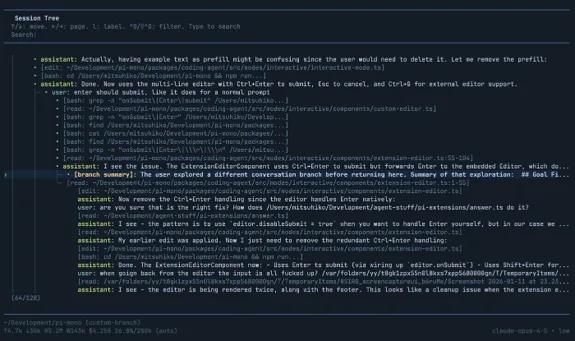
One of Pi’s most original features is its session format. Sessions are stored as tree-structured JSONL (JSON Lines) files, supporting branching and alternative paths within the same conversation.
This makes it possible to return to a previous state, explore alternative solutions and keep track of the different directions taken during the development process. It is a representation that more realistically reflects the way developers and agents collaborate to solve problems.
MCP and the cost of automation
From both the official website and the articles published by Mario Zechner, a clear position emerges regarding the Model Context Protocol (MCP).
The criticism is not aimed at the protocol itself, but at the cost that some implementations introduce in terms of token consumption, complexity and context usage. Some modern MCP servers can occupy a significant portion of the context window before any useful work has even been performed.
Pi’s response is straightforward: favor small tools, readable documentation, specialized skills and easily composable components. This same philosophy explains the absence from the core of features such as sub-agents, integrated planning modes or native to-do lists.
Who is it really for?
Pi is best suited for experienced developers who regularly work from the terminal, local-first users and teams looking to build their own custom workflows.
On the other hand, it may be less suitable for those seeking an out-of-the-box experience, strong built-in guardrails or minimal configuration. The flexibility offered by the project requires a greater willingness to shape and customize one’s own development environment.
Pi in action
The ability to create custom extensions is probably one of the most interesting aspects of the project. With just a few instructions, it is possible to integrate internal company tools, define deterministic workflows and build behaviors tailored to a specific operational context.
Below are a couple of videos demonstrating Pi’s approach in practice.
The first video shows the creation of a custom extension featuring the Intré logo for the coding agent.
The second video shows how the newly created extension evolves into a structured, step-based workflow.
Quick FAQ about Pi coding agent
Before wrapping up, here are some quick questions and answers about Pi Coding Agent.
Is Pi an open-source alternative to Claude Code or Codex?
Yes, but with a very different philosophy. Pi prioritizes simplicity, transparency and customization.
Does Pi support local models?
Yes, through custom providers and dedicated extensions.
Does Pi support MCP?
Not in the product core, but it can be integrated through dedicated extensions.
Is Pi suitable for beginners?
It can also be used by those who are new to AI coding agents, but it delivers its greatest value in the hands of advanced users.
Conclusions
Pi is not the easiest coding agent to adopt, and it probably does not aim to be.
In a market that seems to be racing toward ever higher levels of automation, the project proposes a different direction: fewer built-in features, less abstraction and greater control. Its philosophy is not for everyone, but it offers an interesting response to an increasingly relevant question: how can we maintain transparency and predictability as agents become more and more complex?
Pi does not seek to replace the developer’s judgment. Rather, it aims to provide better tools to exercise it.